Workplace Trends Report Q3/4
Six trends reshaping how organizations lead, retain and perform — with bonus strategic takeaways for business, HR and workplace leaders.
The gap between what organizations think is happening and what employees are actually experiencing is wider than most leadership teams realize. This report cuts through the noise with six data-driven trends that are reshaping retention, AI adoption, workplace culture and employee experience right now — along with specific actions for the leaders responsible for fixing it.
Inside the Report: six trends redefining the workplace right now
The manager squeeze: more responsibility, less support
Manager engagement has fallen to its lowest point in four years — and the consequences are showing up in productivity, retention and AI adoption simultaneously. Most organizations are treating this as a training problem. The data suggests it's a system design failure.
Cutting benefits could save money but cost your culture
Benefits rollbacks look defensible on a spreadsheet. They land very differently with employees. With global engagement at its lowest since 2020 and workers staying out of economic caution rather than loyalty, the organizations cutting support now are building an attrition risk they haven't modeled yet.
AI is not a productivity strategy
Usage is up. Confidence is down. Fear of obsolescence has doubled in a year. Workers are losing 40% of their AI efficiency gains to rework and correction. The organizations realizing genuine productivity gains from AI are treating adoption as a human capacity investment — not a technology deployment.
The workplace: retention weapon or warning sign?
Return-to-office mandates answered one question and left a bigger one open. What employees find when they walk through the door now determines whether your office is building retention or quietly accelerating attrition. Twenty-eight percent of hybrid employees still feel disconnected from culture — even after coming back.
Connection is becoming operational infrastructure
Workplace loneliness is no longer a wellness concern. Lonely employees are seven times more likely to disengage, five times more prone to absenteeism and three times more likely to underperform. Connection no longer forms organically from proximity — and the organizations closing that gap are building structure, not programming.
The rise of the personalized employee experience
Seventy-three percent of employees say they would stay for better, more personalized benefits. They are not asking for more options. They are asking to feel like someone thought about them before they had to ask. The shift from offering benefits to delivering support is where retention is won or lost
BONUS CONTENT: Each trend includes actions specifically for business leaders, people & HR leaders, and workplace & ops leaders — because the same challenge lands differently depending on your role.
Here's a preview of Trend #6:

The rise of the personalized employee experience
Over the past few years, employee expectations have evolved. Employees want to feel known, not just accommodated. Many organizations have confused access to personalization with the experience of it. A benefits portal with 40 options isn’t the same as personalization. Overwhelming employees with choices without proper guidance delivers decision fatigue with better branding.
The gap between what employers believe they’re delivering and what employees actually feel is precisely where engagement, retention and trust quietly erode — and it’s a gap most organizations aren’t measuring because they’re tracking utilization but not the benefits experience.
McKinsey identified this dynamic as far back as 2021: organizations that create tailored, authentic employee experiences strengthen purpose, ignite energy and elevate performance. What’s changed since then is the expectation baseline against which your organization is now being measured.
And that target is on the move.
The workforce is not one audience
Compounding the challenge of heightened expectations is the reality that workforce needs are genuinely fragmented — and a single benefits architecture cannot serve every employee with equal effectiveness. Using a ‘one size fits all’ approach is a recipe for disaster.
Considering the employee experience through the lens of generational groups offers valuable context.
Gen Z workers are building careers in a labor market defined by AI uncertainty, focused on skill relevance and long-term viability in ways that previous generations weren’t at the same career stage. Millennials are navigating caregiving, student loan debt and homeownership pressure while simultaneously questioning whether their skills will remain relevant as AI reshapes their roles. Gen X — largely invisible in the data because they rarely ask for help — is absorbing peak financial pressure: mortgages, college tuition, aging parents and team management responsibilities, all while being expected to lead AI adoption initiatives they received no more preparation for than anyone else. Boomers are managing retirement readiness while being asked to absorb technological transformation at the end of careers built on entirely different assumptions.
Meanwhile, concerns about the cost of healthcare outrank worries about paying for food and groceries, housing costs, utilities and transportation costs, according to a recent KFF poll. More than three-quarters (77%) of U.S. workers report stress about the current economic climate and the majority (88%) of Millennials and Gen Z carry some form of debt (Bank of America). The “sandwich generation” burden — simultaneously caregiving for children and aging parents — is one of the most widespread and least-served needs in most benefits portfolios, affecting a significant share of the mid-career workforce with essentially no targeted support. All of this stress threatens employee engagement as rising disengagement is leading to “ghostworking,” wherein employees perform the appearance of productivity but spend much of their work time on ‘personal fulfillment.’


The delivery paradox
Here is the structural problem most personalization strategies don’t solve: they place the navigation burden on the employee.
Self-service portals, benefits fairs and digital toolkits all require time, cognitive bandwidth and initiative. Employees already operating at or near capacity — which, as Trends 1 through 3 of this report make clear, describes most of the workforce right now — don’t have those resources to spare. The result is utilization rates that embarrass the investment: support that exists on paper, goes unused in practice and generates neither goodwill nor retention value because the people who need it most never successfully access it.
Workplace hospitality, based on personalization, works on the opposite principle. It reduces the distance between need and resolution. It anticipates rather than waits. It delivers rather than directs. The employee experience equivalent isn’t a better portal or a more intuitive enrollment interface. It’s a fundamentally different delivery model — one where someone, or a system backed by someone, understands what employees need and handles it, rather than pointing them toward where they might eventually find it themselves.
That distinction — handle versus point — is the difference between personalization that registers emotionally and personalization that exists administratively. Only one of them drives retention.
Personalization by the numbers
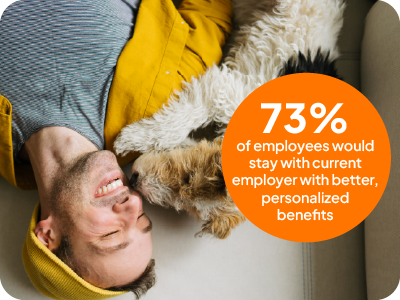
Nearly three-quarters (73%) of employees say they would stay with their current employer for better, more personalized benefits programs (Hub International ). The instinct is to read that as a call for more options, more offerings, a broader menu. That’s not quite right.
Employees aren’t asking for more to choose from. They’re asking to feel like someone thought about them before they had to ask. Those are different requests and they require different responses. More options delivered through the same portal addresses sounds helpful but it may not add the value intended. Offering proactive, friction-free, visible support shows employees you understand their challenges. Which path provides employees a better answer to the question that determines whether they stay: does this organization actually care about me?

The question worth asking
The organizations closing this gap aren’t necessarily spending more. They’re delivering differently — shifting from episodic, enrollment-driven benefits support to continuous, daily-use personalization that employees encounter as part of their regular work lives rather than only during annual open enrollment or moments of acute need.
Proactive support — the kind that arrives before employees have to ask for it — sends a signal that benefits enrollment never can: we see you and understand you. That signal is what drives engagement, trust and the kind of retention that doesn’t depend on labor market conditions to hold.
The question for your organization is whether your current delivery model can actually close the gap between what you offer and what employees need. Adding a dozen more benefit options won’t do it. A more sophisticated portal won’t close it. Sending more emails isn’t necessarily the answer, either.
The way forward is with an infrastructure built to proactively support people without adding to the cognitive load they’re already carrying.
ACTIONS TO CONSIDER

Business leader takeaway
understand the gap between offering and experience
Most organizations are tracking benefits utilization. Almost none are measuring whether employees actually feel supported. Those are different questions and they produce different answers. Add employee-reported experience quality to your benefits measurement framework — because the gap between what you offer and what employees feel is precisely where engagement, retention and trust erode quietly, without showing up in the data you are currently monitoring.

People & HR takeaway
shift from access to delivery
The structural problem most personalization strategies fail to solve is that they place the navigation burden on the employee. Employees already operating at or near capacity do not have the time or initiative to find and use support that requires effort to access. The shift required is from a portal model to a proactive delivery model — one where support arrives before employees have to ask for it. That shift is what changes the signal from “we offer this” to “we see you.”

Workplace & ops takeaway
embed support into the workday
Employees who are overloaded, distracted or managing personal logistics do not have the time or cognitive space to build meaningful connection — even when they are physically present. Operational support systems that reduce friction in the workday directly create the capacity for relational work to occur. This is where workplace hospitality, concierge services and friction-free logistics stop being amenities and start being infrastructure.